Engineering Drawings: as Contracts
If Machinists work with STEP files, what are drawings really for?

This is part one in a two part series. Next time, I’ll present drawings as APIs.
As a Machinist, part of your job consists of getting a part handoff from an Engineer (Jira, email, over-priced ERP system, etcetera).
This should be (but rarely is) enough to do the job. The handoff usually consists of a STEP file (3D geometry) and a drawing. If your engineer is really good, you don’t actually need the drawing because they will know the reasonable (three sigma RSS) tolerances of your machines and processes and design their assemblies such that they don’t need a ten micron profile tolerance on a spline surface.
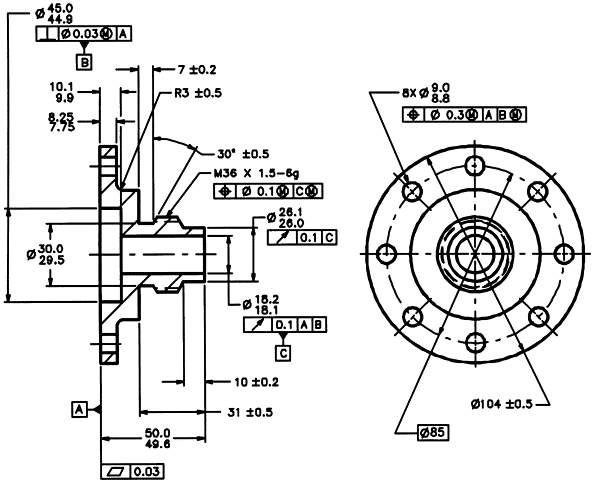
So then, if your engineers are really good and your data pipeline is too, what purpose do drawings serve?
MBD Isn’t Real
Before continuing, I want to explain that I understand MBD does solve some of the challenges listed below, but MBD is not real because it is paywalled even inside of paid for CAD (paper/pen does not require licensing) and for that reason is not reliably usable.
If you do not believe this point, I challenge you to purchase a single seat of the base version of any CAD package, send a model containing MBD to a contractor, and have them redline it and send it back to you with feedback.
What are Drawings For, Then?
Before presenting what I really think drawings are for, let’s look at what they’re useful for outside of the “main use”:
Material Specification - STEP files don’t tell you what the part is made out of
Finish Specification - same as #1
Notes - outside of material, there are a million call outs you may want to include in a drawing to convey important information about the part
Taps/Thread Sizes/etc. - MBD can do these, but, again, it’s unusable
Redlining - it’s still the preferred method for engineers and machinists to communicate with each other outside of CAD
Tolerances - STEP files do not contain tolerances
Raw Material - overall dimensions with +/- tolerances on the part will be included so that the portion of the shop that cuts the raw material down prior to machining will use it to provide the billet to the machinist
Interoperability - you don’t need a computer to read paper. PDFs are now openable with any modern computer
This is a longwinded way of saying “They’re an API”.
What are Drawings Really For?
They’re really just contracts. If you can solve the use cases above (which MBD purports to do) then the drawing becomes the contract between the engineer and the machinist. I know many engineering houses where parts are submitted via Jira tickets and they will contain nothing more than a STEP file and a material call out in the ticket.
Most importantly, in cases where the part is made out of house, it becomes the legal contract between the customer and the vendor. If your drawing says you need a hole in your part to be 1/4” +/- .005”, and the hole comes back as a 1/4” + .01” for a thousand parts, you are not culpable when you don’t pay the vendor (secondary agreements aside).
In terms of liability, they can and will end up in court as evidence.
When you look at drawings through the lens of “these are the terms of our handshake”, they start to make more sense. It is through that lens that you can see why it will be a very long time (decades) before we see MBD replace drawings.